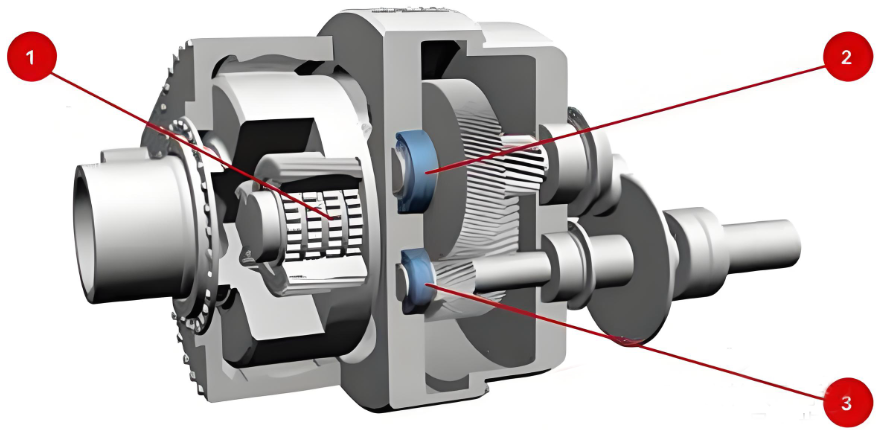
Detailed Explanation of Gearbox Bearing Load Analysis, Life Calculation, and Improvement Measures

Bearings are critical components in gearboxes. Their load-carrying capacity, service life, and reliability directly determine the performance of the entire transmission system. Premature bearing failure can lead to unplanned downtime, increased maintenance costs, and even serious safety incidents. Therefore, accurately analyzing bearing loads, reasonably calculating life, and implementing optimization measures to improve durability are key aspects of gearbox design.

This article systematically covers:

  • Bearing load analysis (static & dynamic loads)
  • Bearing life calculation methods (L10 life, modified life)
  • Common failure modes and improvement measures
  • Modern simulation and condition monitoring techniques

01 Gearbox Bearing Load Analysis

1.1 Basic Bearing Loads

Bearings in gearboxes are mainly subjected to the following loads:

  • Radial load (Fr): Caused by gear meshing forces, shaft self-weight, belt/chain tension, etc.
  • Axial load (Fa): Thrust forces generated by helical gears, bevel gears, or worm drives.
  • Moment load (M): Resulting from gear misalignment, shaft deflection, etc.

1.1.1 Load Distribution in Rolling Bearings

  • Deep groove ball bearings: Primarily radial load, limited axial capacity (≤ 0.5 × Fr)
  • Tapered roller bearings: Can handle combined radial + axial loads (Fa/Fr ≤ 0.7)
  • Cylindrical roller bearings: Pure radial load, cannot take axial load

1.1.2 Equivalent Dynamic Load Calculation

According to ISO 281, the equivalent dynamic load P is calculated as:

P = X·Fr + Y·Fa

(where X and Y are radial and axial load factors from bearing catalogs)

  • When Fa/Fr ≤ e → X = 1, Y = 0
  • When Fa/Fr > e → axial component must be considered

1.2 Dynamic Load Analysis

Dynamic loads from gear meshing significantly affect bearing life. Key factors include:

  • Transmission error (TE) → fluctuating loads
  • Shock and vibration (start-up, braking, tooth breakage)
  • Shaft misalignment → additional bending moments

1.2.1 Dynamic Load Modeling

Use multibody dynamics simulation (e.g., Adams, Romax) to calculate realistic bearing forces, considering:

  • Time-varying gear mesh stiffness
  • Nonlinear bearing clearance and stiffness
  • Extract peak loads under critical operating conditions for fatigue analysis

02 Bearing Life Calculation

2.1 Basic Rating Life (L10 Life)

Defined by ISO 281 as the life that 90% of bearings will reach or exceed:

L₁₀ = (C / P)ᵖ × 10⁶ / (60 n) (in hours)

  • C: Basic dynamic load rating (from catalog)
  • P: Equivalent dynamic load
  • p: Life exponent (3 for ball bearings, 10/3 for roller bearings)
  • n: Rotational speed (rpm)

2.2 Modified Life (Accounting for Lubrication, Contamination, Temperature)

Lₙₘ = a₁ × aISO × L₁₀

  • a₁: Reliability factor (e.g., 0.21 for 99% reliability)
  • aISO: Application-specific factor, depending on:
    • Lubrication condition (κ = ν / ν₁)
    • Contamination level (ηc: 0.1–1.0, higher = cleaner)
    • Fatigue limit of material (significant life extension when Pu/P ≤ 0.05)

2.3 Finite Element Assisted Life Prediction

Modern CAE tools (ANSYS, Romax, SKF Bearing Tool) enable:

  • Contact stress field analysis
  • Fatigue life prediction based on Miner’s cumulative damage rule
  • Import of realistic load spectra for higher accuracy

03 Common Failure Modes and Improvement Measures in Gearbox Bearings

3.1 Main Failure Modes

(Early failure leads to downtime, high repair costs, and safety risks — specific modes not exhaustively listed but implied: fatigue, wear, overheating, etc.)

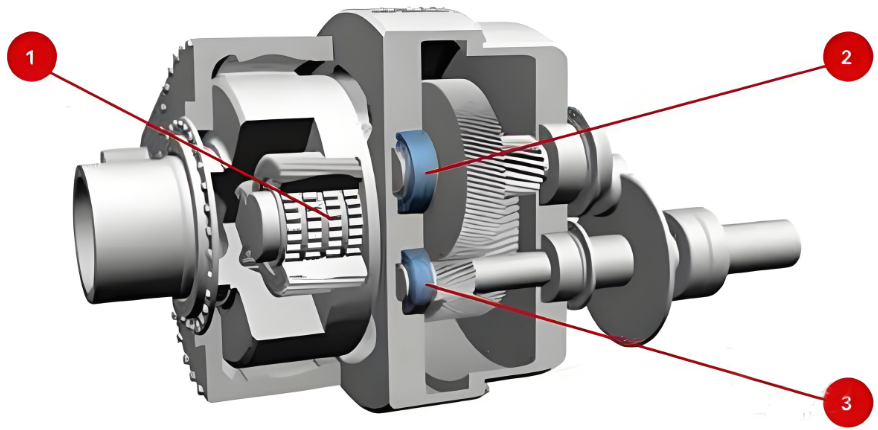
3.2 Optimization Measures to Extend Bearing Life

3.2.1 Bearing Type Selection Optimization

  • High-load conditions → tapered roller bearings or CARB toroidal roller bearings
  • High-speed conditions → hybrid ceramic bearings (Si₃N₄ rolling elements)
  • Misalignment accommodation → spherical roller bearings (allow up to ~2° misalignment)

3.2.2 Lubrication Optimization

Lubrication methods:

  • Oil bath (suitable for low speed)
  • Oil jet lubrication (high-speed gearboxes, oil pressure 0.2–0.5 MPa)
  • Oil-air lubrication (extreme high speed, DN > 1×10⁶)

Lubricant selection:

  • Mineral oil (general conditions)
  • Synthetic oil (high temperature, long life)
  • EP (extreme pressure) additives for heavy loads

3.2.3 Assembly and Alignment Optimization

  • Shaft-bearing interference fit (e.g., H7/k6 or H7/m6)
  • Proper preload / clearance adjustment for tapered bearings
  • Laser alignment (shaft misalignment < 0.02 mm per 100 mm)

3.2.4 Structural Optimization

  • Increase bearing housing stiffness to reduce deformation-induced misalignment
  • Use elastic supports to dampen vibration transmission
  • Add cooling features to control temperature rise

04 Condition Monitoring and Predictive Maintenance

4.1 Vibration and Temperature Monitoring

  • Vibration analysis (ISO 10816): velocity RMS ≤ 4.5 mm/s for industrial gearboxes
  • Envelope acceleration for early damage detection
  • Infrared thermography to identify abnormal hot spots

4.2 Oil Analysis

  • Ferrography to detect wear particles
  • Viscosity monitoring to assess oil degradation

4.3 Intelligent Predictive Maintenance

  • Digital twin technology for real-time bearing state simulation
  • AI-based fault diagnosis using vibration spectrum pattern recognition

05 Summary

Key factors affecting bearing life:

  • Magnitude and distribution of loads
  • Lubrication condition
  • Assembly precision

Recommended measures to improve life:

  • Optimized bearing selection (ceramic for high speed)
  • Advanced lubrication (oil jet or oil-air)
  • Enhanced condition monitoring for early warning
Rate this post